Cellular Automata
Biham-Middleton-Levine Traffic Model
Simulating phase transitions via dynamic orthogonal traffic grids.
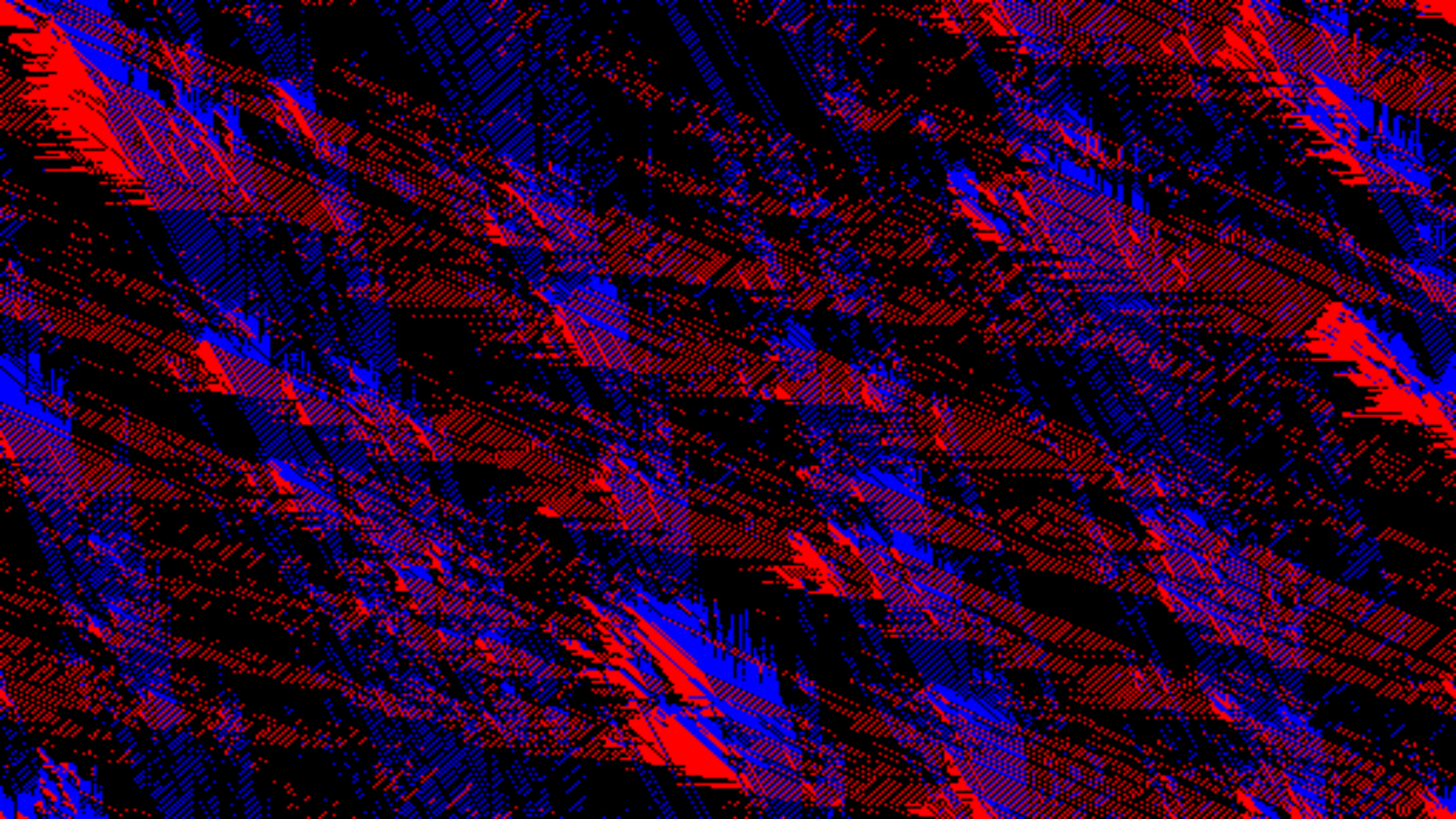
Serving as one of the most fundamental cellular automata, this model is used to study phase transitions and traffic flow dynamics. To make creative use of this principle, STD.DEV implements these discrete orthogonal routing rules directly within the GPU shader pipeline. By calculating massive grids in real-time, this high-performance approach seamlessly transitions from free-flowing matrices to complex, globally jammed grids without ever dropping a frame, transforming rigid structural phase modeling into a deeply expressive visual medium.

Interactive Dataflow and Grid Disruption
In a responsive spatial interface, rigid routing must react to physical disruption. Integrated deeply into the STD.DEV architecture, hardware inputs like a touchscreen swipe or camera feed act as localized interventions within the BML grid. If a user drags their finger across the simulation, their kinetic interaction instantly halts and redirects localized vectors—evoking abstract dataflow simulations, dynamic transit networks, or pulsating circuit boards. This interaction transforms strict orthogonal matrices into a deeply fun, highly tactile spatial puzzle where users actively sculpt the flow of digital information.
Generative AI Diffusion Guidance
Phase transitions offer an incredible framework for generative AI structural conditioning. STD.DEV leverages the rigid orthogonal routing states of the BML traffic model to generate highly complex urban grids and architectural layouts via real-time diffusion models. By routing the deterministic jammed and free-flowing matrices directly into the AI's control networks, STD.DEV forces the generative model to build strict, intersecting megacities and circuit layouts that perfectly adhere to the underlying traffic logic.
How does STD.DEV implement the Biham-Middleton-Levine traffic model?
STD.DEV implements the discrete orthogonal routing rules of the Biham-Middleton-Levine traffic model directly within the GPU shader pipeline.
What kind of visual transformations can be achieved by calculating massive grids in real-time using the BML model?
How do hardware inputs like touchscreen swipes affect the BML grid simulation in STD.DEV?
What is the business value of transforming rigid orthogonal matrices into a tactile spatial puzzle?
How does STD.DEV utilize phase transitions from the BML traffic model for generative AI?
What is the purpose of routing deterministic matrices directly into the AI's control networks in STD.DEV?
What kind of outputs can be generated by using the BML traffic model's routing states to guide generative AI?
Why is the Biham-Middleton-Levine traffic model described as a fundamental cellular automaton?