Cellular Automata
Cellular Automaton Cyclic
Modeling organic self-organization through competitive cellular cycles.
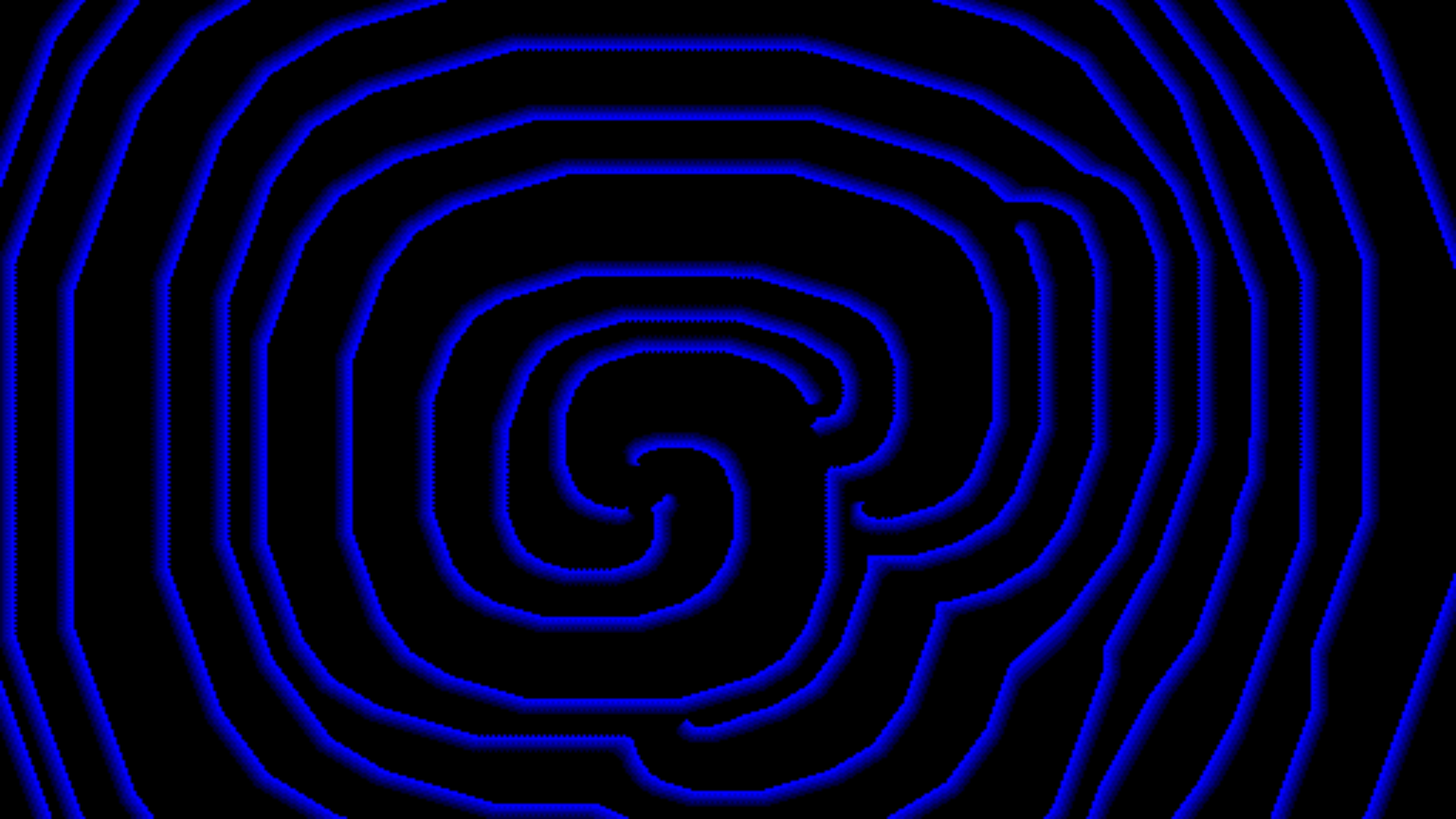
Complex self-organization is modeled through competitive cycles, where each cell advances its state by consuming its neighbors. To simulate this organic devouring process for deep creative expression, STD.DEV executes a highly optimized modulo arithmetic operator directly within the GPU shader pipeline. By simultaneously evaluating adjacent neighborhood states across millions of cells in real-time, STD.DEV natively generates mesmerizing, mathematically perfect spirals and expanding wave fronts without sacrificing rendering performance.

Spatial Phase Disruption
True spatial immersion demands that biological algorithms react to physical touch. Within the STD.DEV architecture, hardware inputs like a live camera feed or touchscreen tap act as spontaneous evolutionary leaps within the cyclic grid. If a user's gesture intersects the digital canvas, their kinetic interaction forces an immediate, localized state cycle, instantly triggering cascading spirals that devour adjacent territories. This allows users to physically plant the seeds of complex competitive growth, creating an incredibly fun, tactile living medium.
Generative AI Diffusion Guidance
The predictable, mesmerizing loops of cyclic consumption provide an optimal latent constraint for time-based generative models. STD.DEV extracts the continuous expanding spiral fronts from the Cyclic Cellular Automaton and uses them as a structural conditioning mask for video diffusion pipelines. The AI is forced to follow these looping consumption states, generating infinitely shifting, psychedelic textures where one visual phase organically and mathematically devours the previous.
How does STD.DEV model complex self-organization?
STD.DEV models complex self-organization through competitive cycles where each cell advances its state by consuming its neighbors.
What technology does STD.DEV use to simulate the organic devouring process?
What kind of visual patterns can STD.DEV natively generate?
How do hardware inputs affect the cyclic grid in STD.DEV?
What is the benefit of allowing users to interact with the digital canvas?
How are the patterns generated by STD.DEV used to guide generative AI?
What makes the loops of cyclic consumption optimal for generative models?
What is the role of Spatial Phase Disruption in STD.DEV?
What is the philosophical approach behind STD.DEV's simulation of devouring?
How does STD.DEV achieve real-time generation of complex patterns?