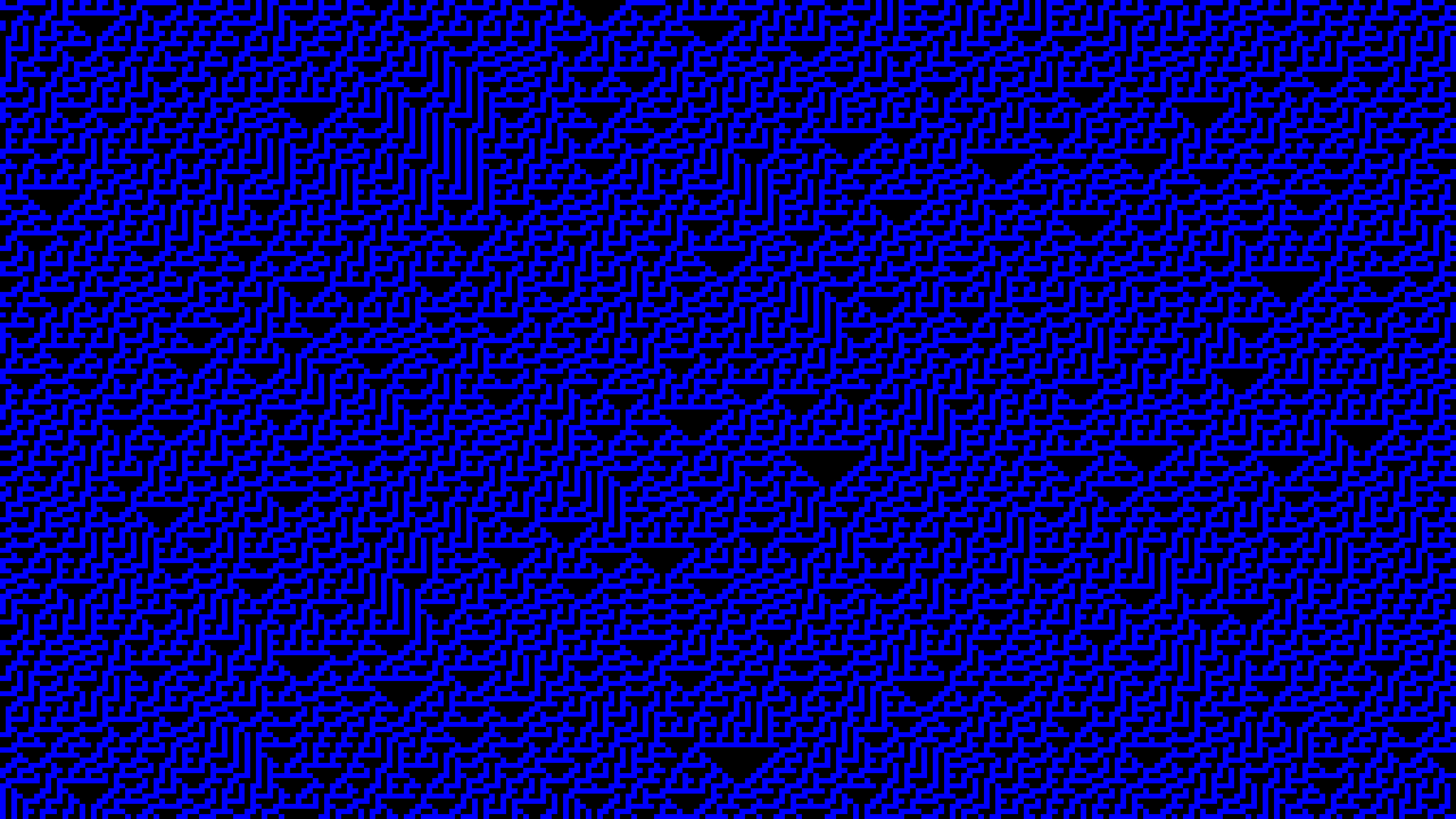
Cellular Automata
Wolfram Elementary Cellular Automaton
Generating infinite 2D complexity from simple 1D binary rules.
By exploring the entire universe of 1D computational systems, infinite 2D complexity (such as Rule 30) is generated from the simplest possible binary rules. To make creative use of this algorithm, STD.DEV implements a highly optimized discrete bitwise evaluator designed to plug directly into the creative GPU shader pipeline. By calculating the generational state of millions of adjacent cells in real-time, STD.DEV natively generates mathematically flawless, self-similar fractals and chaotic tapestries without dropping a single frame.

Interactive Rule Mutation
An immersive digital environment must allow users to manipulate the very fabric of logic. Integrated deeply into the STD.DEV architecture, hardware inputs like a touchscreen drag act as localized rule-breakers within the 1D universe. If a user swipes their finger across the generational cascade, their kinetic interaction can flip the binary state of the initial conditions, instantly triggering massive, unpredictable butterfly effects that alter the entire resulting tapestry. This transforms rigid computational theory into a deeply fun, highly unpredictable visual playground.
Generative AI Diffusion Guidance
The strict binary logic of 1D automata provides an incredibly sharp structural constraint for generative models. Instead of relying on vague prompts, the raw, perfectly deterministic 2D matrices generated by the Wolfram rulesets act as structural boundaries for real-time diffusion models. By feeding these intricate, chaotic tapestries (like Rule 30) directly into an AI model's control network, STD.DEV forces the generative output to build its aesthetic upon pure mathematical cryptography, dictating absolute structural rigidity over AI-hallucinated noise.
How does STD.DEV generate complex 2D patterns from simple 1D rules?
STD.DEV implements a highly optimized discrete bitwise evaluator designed to plug directly into the creative GPU shader pipeline, calculating the generational state of millions of adjacent cells in real-time to generate mathematically flawless, self-similar fractals and chaotic tapestries.
What is the business value of using Wolfram rulesets for generative AI?
How does user interaction affect the generative process in STD.DEV?
What makes the fractals and tapestries generated by STD.DEV unique?
Why are Wolfram rulesets considered a better input for generative AI than vague prompts?
What is the underlying computational system explored by STD.DEV?
How does STD.DEV ensure high performance in generating visual complexity?
What is the philosophical approach to user interaction in STD.DEV?
How are generative AI models guided by the output of Wolfram rulesets in STD.DEV?
What specific computational system is mentioned as an example of generating 2D complexity?