Partial Differential Equations
FitzHugh-Nagumo Model
Dynamic reaction-diffusion systems generating pulsating, neuron-like patterns for complex interactive surfaces.
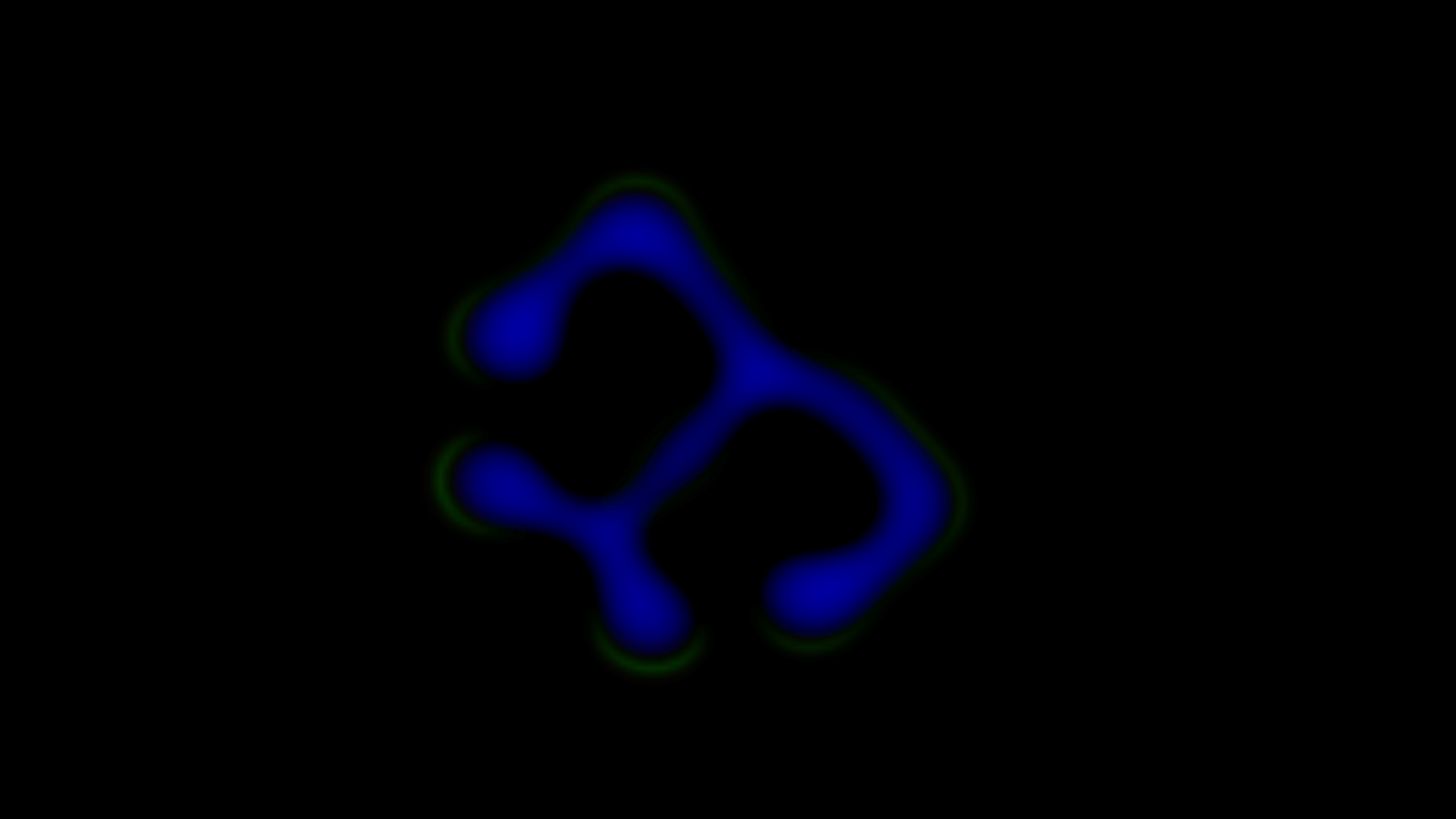
Originally developed to simulate the intricate firing patterns of biological neurons, this sophisticated reaction-diffusion system structurally describes excitable media. To harness this biological complexity for deep creative expression, STD.DEV executes a highly optimized, two-variable oscillator directly on the GPU. By calculating delicate activation and recovery rates across continuous coordinates in real-time, STD.DEV natively generates mesmerizing, life-like neural pulses and complex, sprawling organic patterns without dropping a single frame.

Interactive Biological Excitation
A truly immersive spatial environment requires biological dynamics that react realistically to human interaction. Integrated deeply into the STD.DEV architecture, hardware inputs like a touchscreen drag or mouse click can act as direct action potentials within the excitable medium. If a user swipes their finger across the screen, their kinetic interaction can inject electrical stimuli, instantly triggering mathematically accurate neural pulses that organically propagate and spiral. This can transform a static digital display into a highly engaging, living biological interface.
Generative AI Diffusion Guidance
Biological excitability presents an entirely new frontier for controlling generative art. The rhythmic, sprawling action potentials of the FitzHugh-Nagumo oscillator yield dynamic neural pulses that STD.DEV integrates directly as structural conditionings for diffusion models. Rather than static noise maps, these living, pulsing topographies instruct the AI on exactly how and where to organically grow its generated structures over time. STD.DEV dictates this rhythmic evolutionary flow, bridging the gap between deep mathematical biology and cutting-edge artificial intelligence.
How does the FitzHugh-Nagumo model simulate neural firing patterns?
The FitzHugh-Nagumo model simulates neural firing patterns by structurally describing excitable media as a sophisticated reaction-diffusion system.
What hardware is used to run the STD.DEV implementation of the FitzHugh-Nagumo model?
How does STD.DEV generate neural pulses and organic patterns?
How can user interactions act as action potentials in the STD.DEV system?
What is the impact of a user swiping their finger on the screen within the STD.DEV system?
How does STD.DEV utilize biological excitability for generative art?
What is the benefit of using FitzHugh-Nagumo oscillator outputs to condition diffusion models?
What is the role of STD.DEV in bridging biology and AI?
What makes the STD.DEV system create a living biological interface?
What are the key components of the STD.DEV implementation for creative expression?