Partial Differential Equations
Gray-Scott Model
Reaction-diffusion simulation generating intricate, organic chemical patterns and continuously evolving geometries.
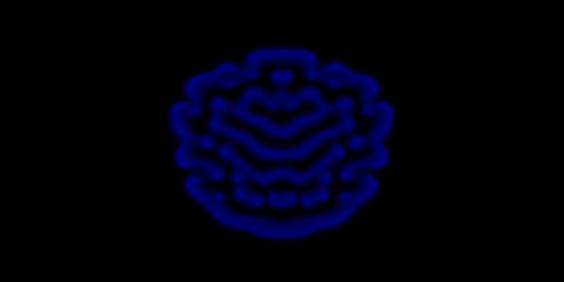
Simulating the life and death of two interacting chemical species—a 'nutrient' and a 'consumer'—forms the basis of this profound reaction-diffusion system. To unleash this biological complexity across the web, STD.DEV executes a highly optimized, 9-point Laplacian operator directly on the GPU. By calculating delicate feed, kill, and diffusion rates across spherical and planar coordinate systems in real-time, STD.DEV transforms raw mathematics into mesmerizing, self-replicating organic patterns—from cellular division to intricate coral structures—without dropping a single frame.
Spatial Interaction as Chemical Stimulus
A truly immersive digital experience requires an environment that breathes and reacts. Integrated seamlessly into the STD.DEV architecture, physical hardware inputs like a touchscreen or mouse can act as direct chemical catalysts within the simulation. A user's click or drag can dynamically inject 'nutrient' concentrations into the simulation grid, causing the digital organism to realistically grow, mutate, and wrap around the point of contact. This can lead to a highly engaging interaction, turning passive pixels into a deeply fun, living medium.
Generative AI Diffusion Guidance
The mesmerizing, self-replicating labyrinths produced by reaction-diffusion kinetics are notoriously difficult to mimic via text prompts. To achieve this, STD.DEV uses the live output of the Gray-Scott model as a dynamic latent constraint for generative video pipelines. The exact boundaries of the evolving chemical nutrient spots map directly to structural guidance layers, allowing the AI to organically populate these intricate morphogenetic pathways with rich visual detail. STD.DEV dictates the underlying geometric labyrinth, ensuring the AI strictly follows the rules of chemical morphogenesis.
How does STD.DEV simulate the Gray-Scott model on the web?
STD.DEV simulates the Gray-Scott model by executing a highly optimized, 9-point Laplacian operator directly on the GPU, calculating feed, kill, and diffusion rates in real-time across spherical and planar coordinate systems.
How can physical hardware inputs influence the Gray-Scott simulation in STD.DEV?
What is the purpose of using the Gray-Scott model's live output in generative video pipelines within STD.DEV?
How does STD.DEV ensure generative AI follows the rules of chemical morphogenesis?
What kind of visual patterns can be generated using the Gray-Scott model in STD.DEV?
What makes the digital experience immersive in STD.DEV's Gray-Scott simulation?
Why is it difficult to mimic reaction-diffusion kinetics using text prompts alone?
What is the core concept behind the Gray-Scott model as implemented by STD.DEV?
What is the performance goal of STD.DEV when simulating the Gray-Scott model?
How does STD.DEV leverage generative AI for visual detail in its simulations?