Partial Differential Equations
Quantum Wave Equation
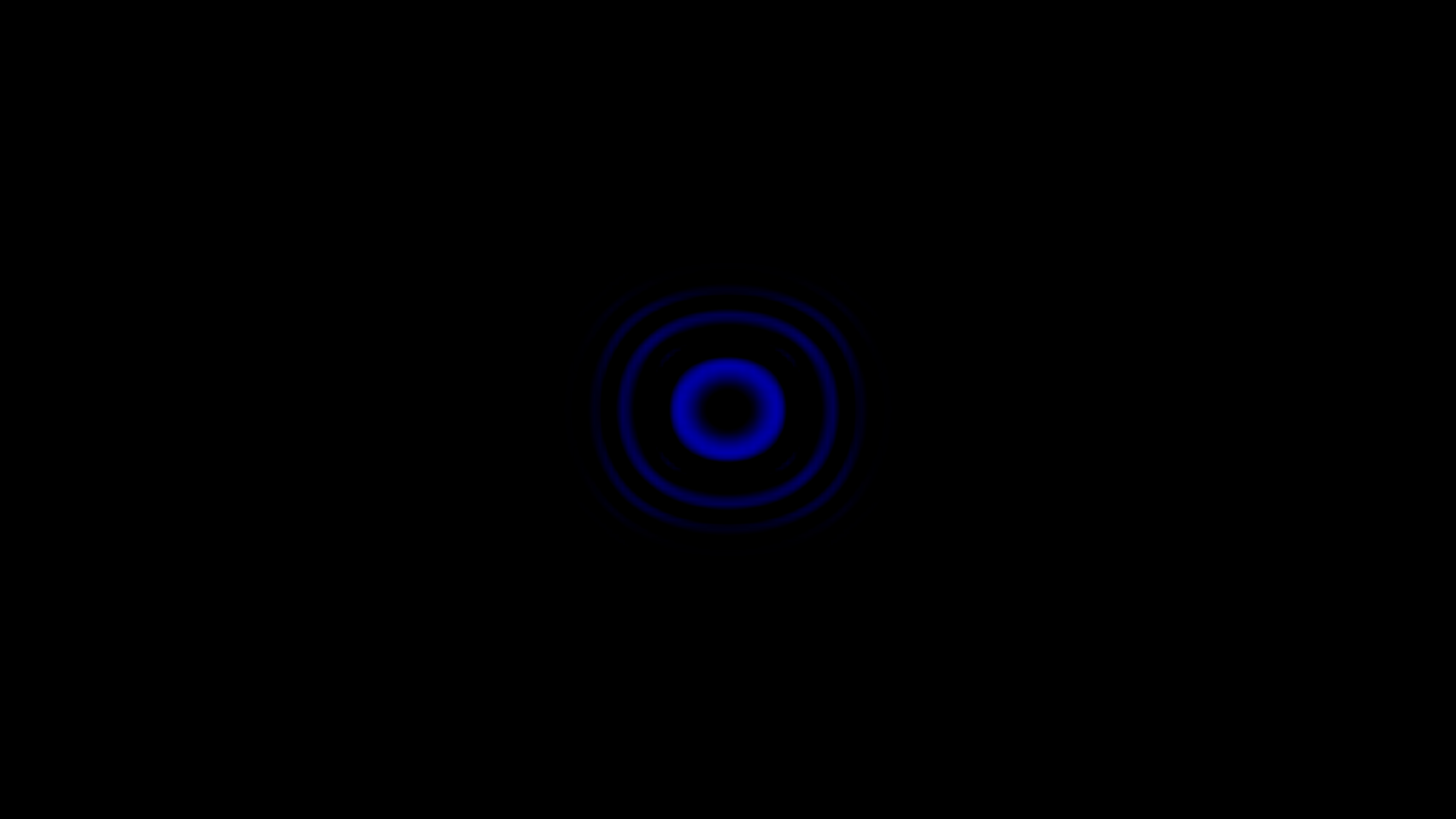
Foundational probability distribution simulation visualizing subatomic particle behaviors and interference patterns.
The evolution of subatomic particle probabilities over time is defined by this fundamental mathematical model. To harness this immense computational complexity for deep creative expression, STD.DEV implements a highly optimized, linear harmonic displacement operator directly within the GPU shader pipeline. By calculating the continuous wave state and complex Laplacian restoring forces across millions of cellular pixels simultaneously, STD.DEV natively generates breathtaking, mathematically accurate interference patterns and standing waves without sacrificing rendering performance.

Interactive Spatial Superposition
True immersion occurs when a digital environment reacts physically to observation and interaction. Within the STD.DEV architecture, hardware inputs like a touchscreen drag or a live camera feed can act as localized observer events that collapse or excite the simulated quantum field. If a user's gesture intersects the camera view, their kinetic input can inject harmonic momentum, instantly triggering cascading interference ripples that bounce, reflect, and superimpose across the screen. The system can use the device's gyroscope to let users tilt and shift this probability plane, creating an incredibly fun, deeply reactive living quantum surface.
Generative AI Diffusion Guidance
The probabilistic nature of subatomic particles introduces a radically unique method for generative AI control. By extracting the complex phase and standing wave interference from the Quantum Wave Equation, STD.DEV generates highly sophisticated superposition maps. When applied as a structural mask within an AI generation pipeline, these maps instruct the diffusion model on exactly where to collapse visual probabilities into sharp focus and where to maintain harmonic uncertainty. STD.DEV dictates this subatomic logic, enabling visual aesthetics that natively reflect quantum mechanical principles.
How does STD.DEV calculate wave states for rendering?
STD.DEV calculates the continuous wave state and complex Laplacian restoring forces across millions of cellular pixels simultaneously within the GPU shader pipeline using a highly optimized, linear harmonic displacement operator.
What hardware inputs can trigger changes in the simulated quantum field within STD.DEV?
How does STD.DEV use generative AI for visual control?
What is the business value of STD.DEV's approach to generative AI?
How does STD.DEV achieve interactive spatial superposition?
What is the purpose of the linear harmonic displacement operator in STD.DEV?
How does STD.DEV allow users to interact with the probability plane?
What is the underlying mathematical model that STD.DEV utilizes?
Why is the probabilistic nature of subatomic particles significant for generative AI in STD.DEV?
What is the role of the gyroscope in STD.DEV's user interaction?