Partial Differential Equations
Saffman-Taylor Instability
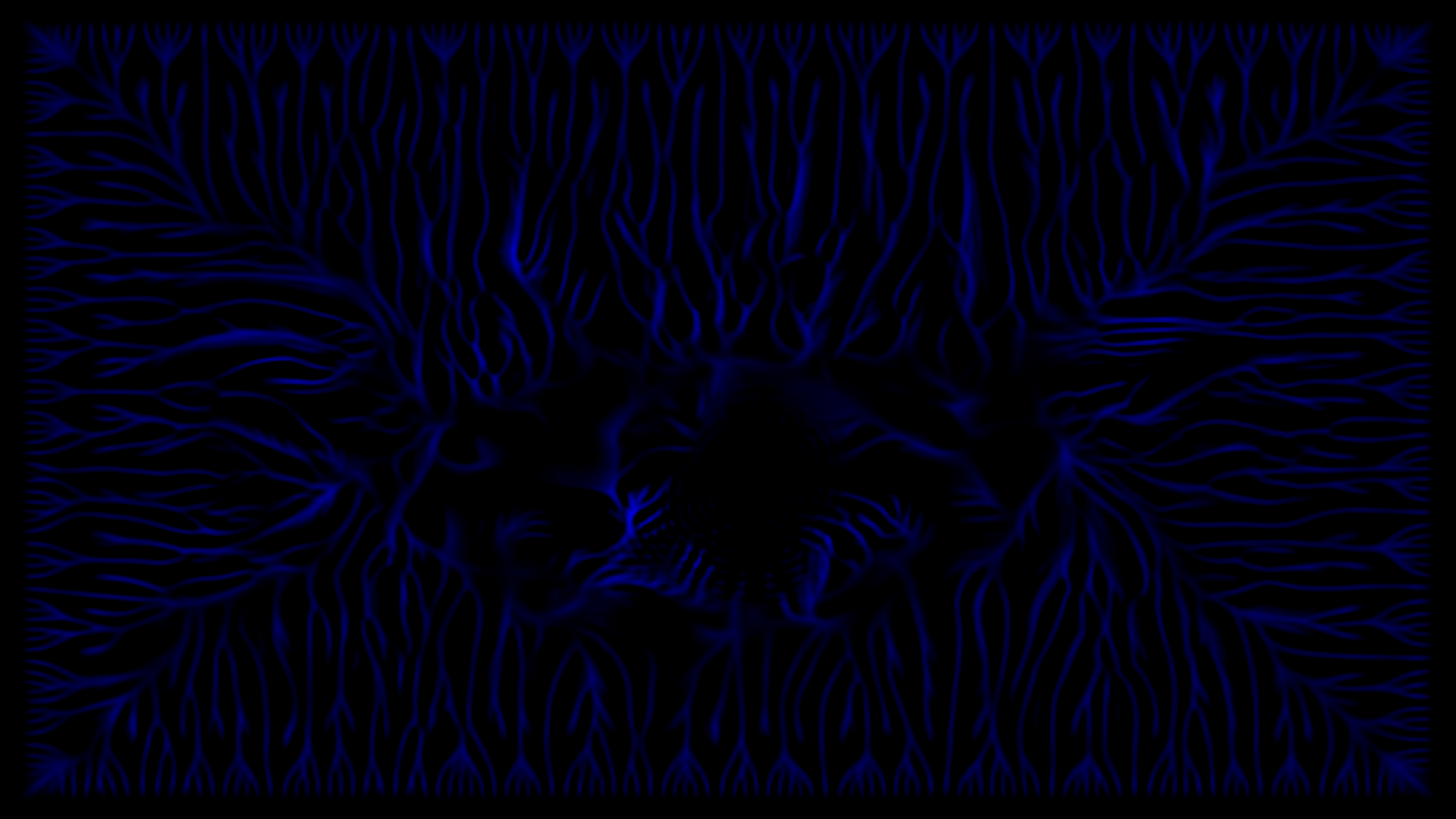
Fluid dynamics simulation modeling intricate viscous fingering and organic boundary instabilities.
When a less viscous fluid displaces a more viscous one, complex, branching "viscous fingering" patterns rapidly emerge. To computationally resolve this intricate hydrodynamic interface on the web, STD.DEV executes an advanced, multi-pass Laplacian solver directly within the GPU shader pipeline. By simultaneously calculating the precise divergence and rotational curl of the velocity field across adjacent pixel neighbors in real-time, STD.DEV natively generates breathtaking, high-precision capillary instabilities and organic branching without sacrificing rendering performance.

Viscous XR Displacement
A truly immersive spatial environment requires fluid dynamics that react realistically to human interaction. Integrated deeply into the STD.DEV architecture, hardware inputs like a touchscreen drag or mouse click can act as physical injection points within the viscous medium. If a user swipes their finger across the screen, their kinetic interaction can displace the digital fluid, instantly triggering mathematically accurate viscous fingering that elegantly branches and weaves. This can transform a static digital display into a highly engaging, living hydrodynamic interface.
Generative AI Diffusion Guidance
Viscous fingering and capillary instabilities produce organic branching that feels profoundly alive. STD.DEV leverages these intricate boundary evolutions by feeding the exact displacement vectors of the Saffman-Taylor solver directly into the spatial conditioning layers of a generative diffusion model. As the less viscous fluid mathematically penetrates the denser one, the AI is constrained to generate imagery strictly along these explosive, branching paths. STD.DEV dictates the capillary flow, merging strict hydrodynamic physics with highly stylized generative outputs.
How does STD.DEV computationally resolve Saffman-Taylor instability for web display?
STD.DEV computationally resolves Saffman-Taylor instability by executing an advanced, multi-pass Laplacian solver directly within the GPU shader pipeline, calculating the divergence and rotational curl of the velocity field across adjacent pixel neighbors in real-time.
How does user interaction influence the fluid dynamics in STD.DEV?
What is the role of generative AI in STD.DEV's display of viscous fingering?
How can STD.DEV transform a static digital display into an engaging interface?
What is the business value of creating a living hydrodynamic interface?
How does STD.DEV merge physics with generative outputs?
What is the core principle behind the emergence of 'viscous fingering' patterns?
What specific computational method does STD.DEV employ for hydrodynamic interfaces?
How does STD.DEV ensure high-precision capillary instabilities without performance loss?
What is the philosophical approach to integrating user input in STD.DEV's fluid dynamics?